新書推薦:

《
百家争鸣与中华文明的哲学突破
》
售價:HK$
115.5

《
孟子学术流传与秦汉价值重构
》
售價:HK$
110.0

《
中国早期城市与文明起源 一部中国早期城市发展简史,解读城市与文明交织共生的规律
》
售價:HK$
96.8

《
只要我还在创作 角谷美智子访谈录
》
售價:HK$
74.8

《
国医大师邓铁涛 治未病从孩子抓起 中医治未病 二十四节气顺时调养 常见病预防 中医健康体检 广东科技
》
售價:HK$
54.9

《
英国都铎王朝君主形象塑造与政治文化变迁
》
售價:HK$
184.8

《
从一道高三数学模拟测试题的背景谈起:兼谈等周问题与等周不等式
》
售價:HK$
74.8

《
《仪礼》版本研究:全三册
》
售價:HK$
383.9
|
| 內容簡介: |
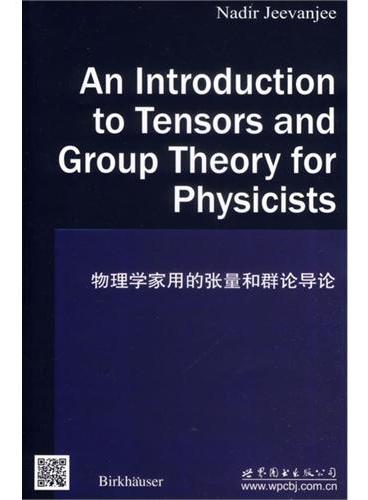
This book is composed of two parts: Part I (Chaps. I through 3) is an introduction to tensors and their physical applications, and Part II (Chaps. 4 through 6) introduces group theory and intertwines it with the earlier material. Both parts are written at the advanced-undergraduatebeginning graduate level, although in the course of'' Part II the sophistication level rises somewhat. Though the two parts differ somewhat in flavor,l have aimed in both to fill a (perceived) gap in the literaiure by connecting
the component formalisms prevalent in physics calculations to the abstract but more conceptual formulations found in the math literature. My firm beliefis that we need to see tensors and groups in coordinates to get a sense of how they work, but also need an abstract formulation to understand their essential nature and organize our thinking about them.
|
| 目錄:
|
Part I Linear Algebra and Tensors
I A Quicklntroduction to Tensors
2 VectorSpaces
2.1 Definition and Examples
2.2 Span,Linearlndependence,and Bases
2.3 Components
2.4 LinearOperators
2.5 DuaISpaces
2.6 Non-degenerate Hermitian Forms
2.7 Non-degenerate Hermitian Forms and Dual Spaces
2.8 Problems
3 Tensors
3.1 Definition and Examples
3.2 ChangeofBasis
3.3 Active and Passive Transformations
3.4 The Tensor Product-Definition and Properties
3.5 Tensor Products of V and V*
3.6 Applications ofthe Tensor Product in Classical Physics
3.7 Applications of the Tensor Product in Quantum Physics
3.8 Symmetric Tensors
3.9 Antisymmetric Tensors
3.10 Problems
Partll GroupTheory
4 Groups, Lie Groups,and Lie Algebras
4.1 Groups-Definition and Examples
4.2 The Groups ofClassical and Quantum Physics
4.3 Homomorphismandlsomorphism
4.4 From Lie Groups to Lie Algebras
4.5 Lie Algebras-Definition,Properties,and Examples
4.6 The Lie Algebras ofClassical and Quantum Physics
4.7 AbstractLieAlgebras
4.8 Homomorphism andlsomorphism Revisited
4.9 Problems
5 Basic Representation Theory
5.1 Representations: Definitions and Basic Examples
5.2 FurtherExamples
5.3 TensorProduet Representations
5.4 Symmetric and Antisymmetric Tensor Product Representations
5.5 Equivalence ofRepresentations
5.6 Direct Sums andlrreducibility
5.7 Moreonlrreducibility
5.8 Thelrreducible Representations ofsu(2),SU(2) and S0(3)
5.9 ReaIRepresentations andComplexifications
5.10 The Irreducible Representations of st(2, C)nk, SL(2, C) andS0(3,1)o
5.11 Irreducibility and the Representations of 0(3, 1) and Its Double Covers
5.12 Problems
6 The Wigner-Eckart Theorem and Other Applications
6.1 Tensor Operators, Spherical Tensors and Representation Operators
6.2 Selection Rules and the Wigner-Eckart Theorem
6.3 Gamma Matrices and Dirac Bilinears
6.4 Problems
Appendix Complexifications of Real Lie Algebras and the Tensor
Product Decomposition ofsl(2,C)rt Representations
A.1 Direct Sums and Complexifications ofLie Algebras
A.2 Representations of Complexified Lie Algebras and the Tensor
Product Decomposition ofst(2,C)R Representations
References
Index
|
|

 購物車/收銀台(0) | 在線留言板
| 付款方式
| 運費計算
| 聯絡我們
| 幫助中心 |
加入書簽
購物車/收銀台(0) | 在線留言板
| 付款方式
| 運費計算
| 聯絡我們
| 幫助中心 |
加入書簽 HOME
HOME 新書上架
新書上架 暢銷書架
暢銷書架